Gold's 30% Fall

Executive Summary
On 29 January 2026, the gold price registered an intraday high of $5,595/oz. Yesterday, the gold price registered a low of $3,852/oz. This represents a fall of 31.15% from the high. During this time, US government debt surpassed $40 trillion, a doubling in under ten years. The most recent trillion dollars of borrowing accumulated in less than five months. Annual interest payments for the US Treasury are now approximately $1.1 trillion, exceeding the US defence budget. This creates a potentially self-reinforcing cycle: deficits increase debt, higher debt increases interest costs, higher interest rate costs contribute to further deficits and borrowing requirements.
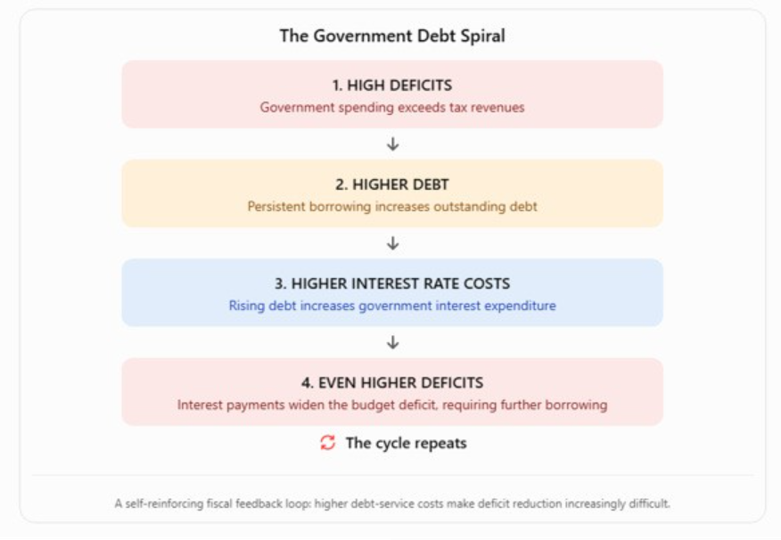
In the context of ever rising debt levels, gold’s price decline seems confusing. Gold investors appear ‘wrong’ even though the thesis is stronger than ever. Those who eschewed the merit of gold, relegating it as an ‘old relic’, appear vindicated. The recent correction in gold distracts investors from the fundamental issue. Developed country governments have made promises they cannot deliver. They have four potential paths to resolve the mounting problems that become increasingly obvious:
1. Admit the situation, renege on healthcare and pension promises for all but the most vulnerable.
2. Default on their debt.
3. Conduct austerity, cutting all benefits and reducing government spending.
4. Use currency debasement and inflation to reduce the size of debt in real terms, using tax revenues on nominally higher GDP in the future to repay debt denominated in a vastly depreciated currency.
All these options are painful. Voters will react accordingly and politicians don’t want to be the messengers. Accordingly, option four seems the most likely. Under this scenario, no identifiable politician needs to give the bad news, rather, purchasing power erodes gradually and today’s debt can be repaid by tomorrow’s inflated prices. Short-term price movements can obscure the longer-term purchasing-power risks that form part of our investment assessment. Within our portfolios, we regard gold as insurance against the possibility that governments ultimately manage excessive debt through currency debasement and inflation.
Gold’s correction
The decline in the price of gold this year reflects rapidly rising interest rates, a stronger US dollar and the unwinding of an increasingly crowded investment position. On 29 January alone, gold fell approximately 12%, its worst daily performance in more than 40 years. Gold’s lack of yield or earnings makes it vulnerable when real interest rates rise as the ‘opportunity cost’ of holding an asset without yield or growth becomes greater every day. These characteristics, however, do not undermine its longer-term role as a scarce asset with thousands of years of history as a store of value, without counterparty risk. When governments may ultimately meet their obligations through dollars with reduced purchasing power. These characteristics become especially appealing.
Financial Repression
There are parallels with the period following the Second World War, when, like now, US debt exceeded the size of the economy. The Federal Reserve maintained artificially low interest rates, allowing government to reduce its wartime debt relative to GDP by allowing debt to inflate away in real terms. Inflation exceeded bond yields throughout much of the thirty years following the War. Returns earned by government bondholders and cash deposits fell short of inflation and such ‘conservative’ investors experienced a reduction in real wealth despite receiving their contractual payments. Central Banks artificially suppressing bond yields to below inflation rates is commonly referred to as ‘financial repression’ or ‘stealth devaluation’. It is insidious and harmful for most, but highly effective in eroding the real value of debt. ‘Financial repression’ is effectively a transfer of wealth from creditors to debtors through negative real interest rates.
World Gold Report
Despite the correction, central banks reportedly * purchased approximately 321 tonnes of gold in the third quarter of 2026, an increase of 42% year-on-year. China and Poland were among the leading buyers. The distinction between speculative investors who are concerned with short-term returns and central banks that are concerned with the long-term composition and security of national reserves, is stark. Central banks exhibit disciplined purchasing behaviours, accelerating their purchases on weakness. In contrast, both jewellery and investment flows exhibit momentum behaviours, selling on weakness and buying on strength. Part of gold’s appeal within our investment framework is that it is not another government’s liability and sits outside the financial system. Central bank reserve managers with a mandate to preserve capital for the long term understand gold’s unique properties.
*Gold Demand Trends: Q3 2026 | World Gold Council
"Part of gold’s appeal within our investment framework is that it is not another government’s liability and sits outside the financial system"
Implications for Portfolio Construction
Whether government or corporate debt; whether stocks or bank deposits, each ‘investment’ is ultimately dependent on future earnings/revenue and a promise to allocate cashflow towards stakeholders. What happens if, for any variety of reasons, that promise cannot be kept?
Cash, bonds and equities all depend on different counterparties and future outcomes. In contrast, gold has no issuer or contractual counterparty.
In the circumstances of forever escalating debt to levels that appear so blatantly unsustainable, in all our multi asset strategies, we have a minimum allocation to gold which is held in vaults on an allocated and segregated basis. For the Somerston Rainy Day Fund (‘SRDF’) that is specifically mandated to provide insurance against adversity, such as currency debasement, around a third of the portfolio is permanently allocated to gold bullion. For Somerston Multi Asset Fund (‘SMAF’) and Somerston Managed Growth Fund (‘SMGF’) we have a self-imposed minimum threshold of around 5%.
In recent days, we have increased allocations to gold for SMAF and SMGF beyond 5%. Considerations are:
- In the last twelve months gold has underperformed oil, copper and the S&P by 36%, 20% and 18% respectively. Accordingly, gold appears reasonably oversold.
- In January, large derivative traders had the second largest short position since the 2012 top. They are presently significantly reducing that short position.
- 10-year real yields have risen 100 basis points this year. The US has the highest real yields for 25 years outside of a short period during 2008. To deflate away the debt, real yields need to be ‘managed’ lower. Imposing escalating interest rate costs on your highly indebted government seems an unsustainable strategy.
The merest whiff of yield curve control– a tactic instrumental to achieving stealth devaluation of the currency - would, in our view, be supportive of the investment case for precious metals; echoing the moves in early August when Treasury Secretary Scott Bessent proclaimed “I am the house” in relation to intervention in the Japanese bond market.
Conclusion
If the government cannot balance the books in the good times, just imagine what deficits will be in the bad times.
There is a crucial distinction between capital preservation and real purchasing-power preservation. A government can honour every bond payment while still imposing substantial losses on creditors through inflation. These considerations inform our assessment of interest-rate sensitivity, inflation exposure, counterparty dependence, currency concentration and liquidity across our portfolios Accordingly, within our investment framework, gold is held primarily as portfolio insurance rather than as a short-term return-generating investment.
The risk to gold over the next 5-10 years is fiscal discipline, robust real economic growth and productivity improvements leading to balanced budgets. Earnings growth has been outstanding in recent years and yet, even during such optimal years, government spending far outpaces tax revenues. If the government cannot balance the books in the good times, just imagine what deficits will be in the bad times.