2025 In Review
Asset Allocation Review

CIO Summary
We consider that equity markets are likely to move higher over the next few months. However, the market cycle is mature, risks are high, and we maintain the view that the best of the returns from this cycle are likely behind us.
There has been a significant improvement in the valuations of several of the ‘defensive assets’—a dynamic that is so often seen at the latter stages of a bull market. This allows our investment strategy to incorporate more balance into the multi-asset portfolios, which we expect will improve prospective risk-adjusted returns.
We maintain a ‘risk-on approach’ but within equities, we are increasingly selective. We prefer the higher quality cohort of the equity market along with emerging markets and resources.
The developments in technology are breath taking. It is hard not to be truly amazed at the progress within AI. We are long-term bulls of technology, but our allocation to the sector is somewhat reduced because of the maturity of the market cycle and the propensity of higher-risk assets to perform poorly during periods of turbulence.
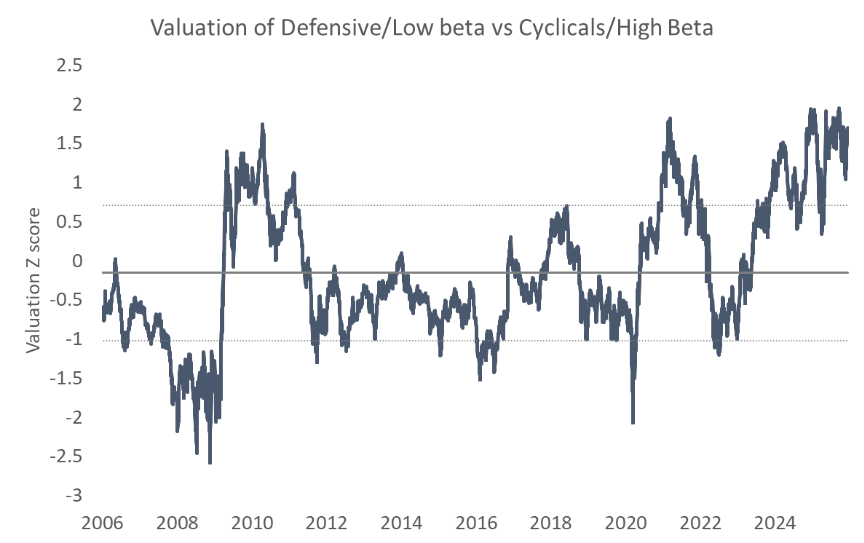
We consider implied inflation expectations in most regions of the world to be surprisingly conservative and therefore inflation-linked bonds are appealing; volatility remains contained; and defensive low-beta equities are significantly more attractively valued than higher-beta cyclical assets.
Monetary debasement continues to be a worrying and persistent feature of our financial environment. Although precious metals are no longer ‘cheap’, they are likely to continue to perform well while governments accelerate the issuance of debt to fund unrealistic policy promises, and Central Banks monetise that debt by performing open market operations which buy that issuance.
Overview
The Market Cycle
The Federal Reserve’s 1998 market intervention to ‘save’ financial markets in response to the failure of the hedge fund LTCM was a crucial moment. It emboldened policy makers and marked the start of an era of ‘market responsive’ policy making. Every time the market ‘wobbles’, a set of policies are introduced that alleviate these immediate market concerns.
Accordingly, we have seen very few market corrections in the past twenty years and those we have endured have been incredibly short-lived. In the past, market forces served as the main check on cyclical excesses and would take time to feed through to correct them; today, this role has largely been assumed by policymakers and is almost immediately discounted by financial markets.
To address the changes in market dynamics, we developed a set of market measures that capture periods of significant market inflows that generally follow these market friendly policy pivots. In the past two decades, most of the equity market return has occurred over a very short period following evidence of significant market accumulation, with returns that are only modestly better than cash outside of these periods.
By our measures, a period of accumulation was evident on the 30th of April 2025, and this period ended on the 20th of October. This suggests that the best returns of this cycle are probably behind us. Moreover, our ‘Real time Leading Indicator (“RTLI”)’, that leads the OECD’s Leading Economic Indicator (“LEI”) by 24 weeks, appears to be modestly rolling over.

Source: Bloomberg/Somerston/Tailwind
Our RTLI measure is ‘noisier’ than the OECD’s LEI, but it has the significant advantage of being based on financial market prices that are known at the end of every trading day and are not subject to revisions. Moreover, as experienced during this cycle, the economy bears increasingly less resemblance to the stock market and a leading indicator that is based on financial conditions, as opposed to economic conditions, provides invaluable information.
While deteriorated, the RTLI is not signalling a period of market weakness, but it does contribute to the idea that the market cycle is mature.
However, any near-term concern of a meaningful market correction was significantly reduced this week. To all intents and purposes, the Federal Reserve announced that they are restarting another era of Quantitative Easing (QE 5). This provides the market with an effective floor over the next few quarters and reduces market risks.
Accordingly, analysis of the market cycle urges a risk-on approach, but its maturity encourages us to be highly selective and gradually introduce defensive assets/strategies. We would need for both the RTLI and our Master Model to turn down to adopt a risk-off approach. This is highly unlikely in the next quarter.
Technology
The quantum of AI investment is mind-boggling, but company reports confirm the notion that we remain in the very early stages of this theme. Microsoft management noted they are “adding AI capacity at an unprecedented scale” and plan to increase AI capacity by more than 80% in fiscal 2026. Management stated that demand remains “significantly ahead of the capacity we have available,” leading to capacity constraints and heavy capital expenditures on GPUs and CPUs. Amazon’s CEO, Andy Jassy, highlighted “strong demand in AI and core infrastructure”, with AWS growing at its fastest pace since 2022. Credo Technology, which enables connectivity solutions, delivered second-quarter revenue of $268.0 million, growing 20% sequentially and surging 272% year-over-year. Management commented that “these are the strongest quarterly results in Credo’s history, and they reflect the continued build-out of the world’s largest AI training and inference clusters. Looking forward, [ …] gives us an outlook with strong revenue growth and profitability through fiscal 2026 and beyond.” Evidently, hardware, infrastructure and datacentres are seeing substantial AI revenue dollars today.
Clearly, the uncertainty of whether AI can bring the service and product revenues required to justify these investments invites a lot of debate. It is important to acknowledge, however, that progress continues to be achieved. Intuit reported that the company is building an “AI-expert platform,” which is driving broad-based growth across TurboTax, QuickBooks, and other products. Duolingo’s management discussed AI-powered tools like video calls with AI characters (e.g., Lily) and conversation practice, noting these address key learning gaps like speaking skills. Snowflake’s CEO, Sridhar Ramaswamy, highlighted accelerated AI monetisation, achieving a $100 million AI revenue run rate ahead of schedule, driven by Cortex AI and Snowflake Intelligence (described as the fastest-ramping new product in company history). It was Jesson Huang, Nvidia’s CEO, who was perhaps the most comprehensive describing the breadth of AI applications: “We are also witnessing a proliferation of agentic AI across various industries and tasks. Companies such as Cursor, Anthropic, OpenEvidence, Epic, and Abridge are experiencing a surge in user growth as they supercharge the existing workforce, delivering unquestionable ROI for coders and healthcare professionals. The world’s most important enterprise software platforms like ServiceNow, CrowdStrike, and SAP are integrating Nvidia’s accelerated computing and AI stack”.
A crucial recent development in the AI roll out is the number of announced collaborations between the foundational models and leading software companies. For instance, Anthropic have announced arrangements with Snowflake, Accenture, Microsoft Azure and IBM; Open AI have announced deals with and Salesforce and Amazon’s AWS. With AI applications spanning virtually every industry, in our view, these collaborations will provide the greatest scale for applications and help the model builders fund the significant investments they have been making.
While we remain overweight to technology stocks, our allocation is currently more moderate than we have held in the recent years. This decision does not reflect lower conviction in the long-term opportunity for these companies but is rather a function of the maturity of the market cycle, and the relative attraction of the ‘Quality’ cohort of the market.
Quality Equity
The ‘steady eddies’ of public markets often lose appeal to investors when there are more exciting things to invest in. The market’s focus on AI companies has contributed to our Quality universe cheapening by around 15% this year alone. Nevertheless, companies such as Stryker, Roper and Autodesk continue to have bright outlooks but are currently available for materially better valuations than in recent years.
Emerging Markets
During 2025, emerging markets (EM) enjoyed a reprieve from the decade long period of underperformance. This was driven both by superior earnings growth and a modest improvement of the valuation gap with developed markets. Performance of emerging markets has been broad based: China +30.4%, Taiwan +32.7%, South Africa +65.6%, Korea +85.3%, Mexico +50.1%, Brazil 42.3% (all in USD terms). This reflects strength in technology, resources and financials, and weakness in the US Dollar. For as long as there is ample global liquidity, broad-based economic growth, especially in commodity markets, and continued US Dollar weakness, we can expect EM to continue to do well supported by reasonably attractive valuations.
Risk Off Assets/Strategies
Inflation Linked Bonds
5–10-year inflation linked bonds offer some of the most attractive terms we have seen in modern memory. In the US, as an example, 10-year government inflation-linked bonds offer a real yield of +1.9% with inflation expectations of 2.27%. On first impression, this may not seem as attractive as in December 2008, when real yields were +2.1% and implied inflation was only 0.1%. However, over the last five years, US inflation has averaged 5.0%, and with the propensity of central banks to monetise the inevitable growth of government debts, in our opinion, the probability of inflation averaging over 2.27% for the next 10 years is somewhat similar to inflation beating 0.1% in 2008. Nonetheless, while the yield curve has steepened, it likely has further to go, and we wish to avoid too much duration as this process remains underway.
Lower Beta vs High Beta
In a bull market, it is intuitive that equities that are not as exposed to the growth themes will underperform. Often, this underperformance is warranted by growth differentials, but when valuations start to get significantly out of kilter, as they are today, an allocation to low beta equities and shorting high beta equities provides the opportunity to expose the portfolio to a highly diversifying strategy with an expected positive return profile during periods of adversity.
Source: Bloomberg/Somerston/Tailwind
Gold
In contrast with the other two risk-off strategies discussed, it is very difficult to base our allocation to gold on a valuation argument. However, gold has centuries of history proving itself as the ultimate asset to protect against fiat debasement and jurisdictional unrest. In the last three years, gold’s relationship with the global US dollar monetary base has been incredibly tight, inferring that it will again provide that hedge against policy error and what seem like the inevitable erosion of fiat currency.
Pleasingly, gold’s most recent pullback ushered in a wave of increased purchases from foreign central banks, just as the Federal Reserve was about to announce another wave of Quantitative Easing. While gold has certainly already registered impressive gains, outperforming all yardsticks such as the growth in money supply and rising debts, the convexity it offers in an extreme event makes it a unique and worthwhile allocation.
Summary
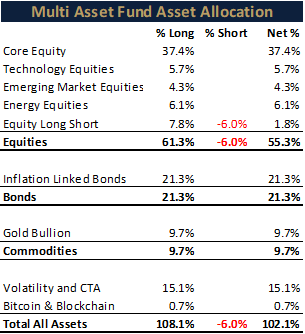
Our views are implemented in the multi asset funds according to their mandates. In the Somerston Multi Asset Fund (“SMAF”) we remain under weight equities to reflect the maturing of the market; we own no credit or traditional government bonds, instead preferring Inflation linked bonds, long volatility strategies and gold as the primary diversifiers.
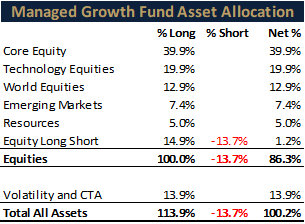
Aligned with its growth mandate, the Somerston Managed Growth Fund (“SMGF”) retains its risk on bias, as we consider there is a low probability of a meaningful correction. Nonetheless, consistent with our views about the maturity of the bull market we have reasonable allocations to equity long/short and long volatility.
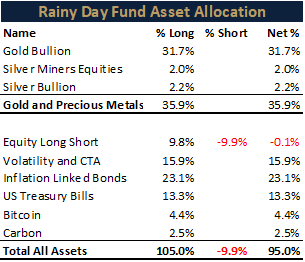
The allocation in the Somerston Rainy Day Fund (“SRDF”) hedges against fiat debasement through our precious metal and bitcoin allocation; an inflationary bust by way of our inflation linked bonds; an equity correction through our equity long/short positions and a massive left tail event through our long volatility strategies.
Closing remarks
Somerston thank all our clients for their support and we wish you a very happy Christmas.
Asset Allocations