Market Cyclicality

Introduction
There is a well-rehearsed playbook for investing through the market cycle. However, that playbook’s sequencing of which asset performs at what stage of the cycle has been utterly distorted in recent years.
The Purchasing Managers Index (PMI) is a timely survey of both services and manufacturers to ascertain the condition of the economy. A measure above 50 indicates conditions improving and below 50 suggests conditions are deteriorating. It serves as a reasonable proxy for the market cycle. For the last 30 years, an investment strategy that invested in equities when the Purchasing Managers Manufacturing Index (PMI) was above 50 and divesting when below 50 (shaded red in chart 1), would have avoided the large equity drawdowns and allowed equity investment to compound during benign environments. Yet, the manufacturing PMI has only just emerged above the level of 50 after the longest period below 50 in modern history (571 days). Using the PMI as a proxy for the market cycle would have urged an investor to be out of Equities and invested in Government bonds since 2022!
Chart 1 – The S&P 500 (blue Line) with periods when the PMI is below 50 shaded in pink. This illustrates that equity bear markets have ordinarily coincided with weak PMIs. The recent bull market has been an exception.

Source: Bloomberg/Somerston
1. Why has the playbook for the market cycle been so badly distorted and
2. What does the upswing in the PMI mean for investors today?
During COVID lockdowns, consumption was restricted and financial handouts ballooned. It is estimated that in the US alone, over $2.5 trillion of personal ‘excess’ savings accrued through that time. This led to significant pent-up demand and by most measures, those excess savings have now been spent.
At the same time, there was rapid technological innovation to provide solutions to the stay-at-home dynamic, which together with Semiconductor R&D breakthroughs, led to a period of significant acceleration in Technology adoption, applications and investment.
The combination of above average personal consumption and significant advancements in technology investment seems largely responsible for the market upswing we have seen since 2022. Indeed, consumer discretionary stocks and technology are the best performing sectors. However, many areas of the economy have been in recessionary conditions, and this has caused Global Central Banks to begin cutting interest rates even though equity markets are near all-time highs.
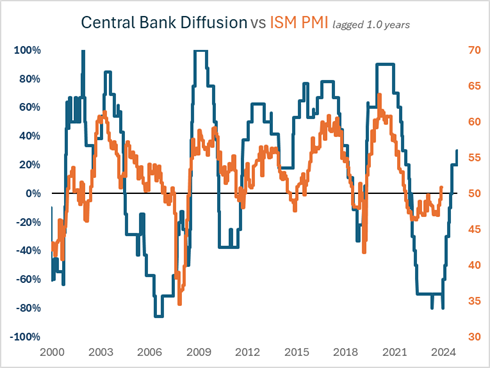
As astounding as it seems, with equity markets near all-time highs, the recent upswing in both the Services and Manufacturing PMIs are reminiscent of the start of an equity bull market. Moreover, the readings from the PMI’s are not an aberration – they are accompanied by improved small business optimism and a significant increase in new orders. This is also entirely consistent with Central Bank Interest rate policy which leads the market cycle by about a year.
Chart 2- the PMI Index vs A Diffusion of Central Banks rate cutting.
Source: Bloomberg/Somerston
As you would expect, there are several early cycle investment ideas that have performed extraordinarily well over recent years and their valuations are unfortunately now unattractive, but equally there are many others that hold more appeal from a valuation perspective.
If the recent improvement in new orders and PMI indicators continues, the playbook is clear: Commodities, smaller companies, emerging markets, cyclical currencies (and even Bitcoin) have high sensitivity to improving PMI’s, while the US Dollar and Large caps generally underperform. But will the playbook work this time around?
Many of these early cycle investments have several compelling attributes. They have generally underperformed for several years; they generally perform better with a weak US Dollar and their valuations are depressed. This combination of factors makes several of these investments compelling.
A large factor that would swing the odds in favour of these assets would be a significant change to China Policy. China’s ten year bond yield has collapsed to 1.6% and, without policy action, China may be resigning itself to a multi decade period of Japan-esque stagnation.
We remain concerned that many of these early cycle investments lack the catalysts to deliver anything other than a ‘mean reverting’ performance without a distinct acceleration in Commodity demand. However, there are two areas of interest for us.
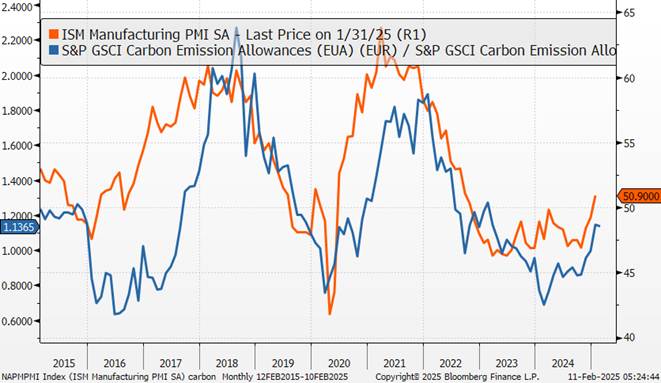
The European Carbon Credit markets have a cyclical tendency, but they have the unusual attribute that issuance falls substantially and at an accelerating rate over the next five years. With supply of credits entering their most rapid decline in the next few years and structural demand that is not diminishing as fast as it needs to, there is a potential confluence of a supply demand imbalance into a cyclical upswing. Moreover, presently the natural gas market is rising, causing the coal to gas spread to reach levels that encourage power providers to switch to coal where possible – and thereby they are required to buy more carbon credits to offset. The Somerston Multi Asset Fund presently has a 2.8% allocation to European Carbon Credits.
Chart 3 – PMI ISM Manufacturing compared to the rate of change of EU Carbon Credits.
Source: Bloomberg/Somerston
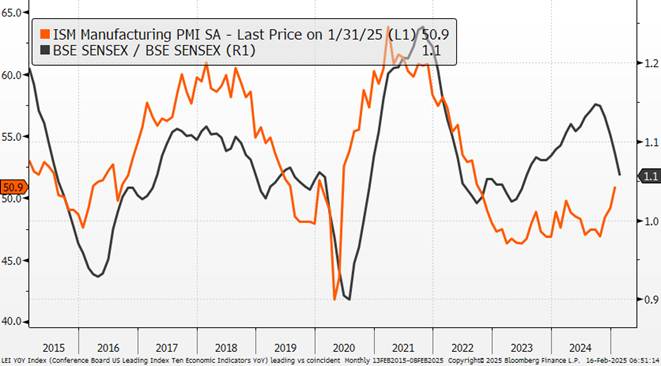
Another usual beneficiary of the early cycle is Emerging Markets. They have underperformed developed markets for 15 years and trade at 12 x earnings. This has much to do with China’s moribund economy but with its 10-year government bond yield at 1.6%, the surprise could be more pro-growth policies than the market presently expects. However, India is a market that is not dependent on China policy or resurrection in Commodity prices that has significantly pulled back in recent months. The Somerston Multi Asset Fund has a 2% allocation to India at the moment.
Chart 4 – PMI ISM Manufacturing compared to the rate of change of India.
Source: Bloomberg/Somerston
Summary
The rise in Global and US PMI Indexes above the crucially important level of 50 deserves investor attention. It is likely to have positive ramifications for many assets that have languished for many years, and it may well allow the disparity between Technology and the rest of the market to normalise for a period.
We continue to see the risks as elevated but the sharp rise in cyclical conditions, which have accelerated with the inauguration of President Trump, has investing consequences for the foreseeable future.