Market Positioning Update
In recent publications, we expressed our view that the equity market was ‘mature’. Historically ‘mature’ markets may have laboured higher for several months, but the lion’s share of returns are behind us. Accordingly, we increased diversification, and we have been poised to meaningfully reduce risk when our models indicated it was timely to do so.
There have been three notable events so far this year.
The speed of AI application development has caught most by surprise, and this has caused an abrupt modification of long-term expectations from the established software sector.
Large private credit funds have struggled. A few high-profile business failures have caused loan holding values to go from par value to zero overnight. This has caused investors to seek liquidity at the same time in an illiquid market.
The invasion of Iran with the consequent cessation of traffic through the Strait of Hormuz has caused a dramatic disruption to energy, chemical and fertiliser markets. With no prospect of a near-term resolution, this will have very unwelcome consequences for global inflation.
Such ‘events’ are consequential if they materially impact the outlook for growth and inflation. For the moment, our Real Time Leading Indicator (‘RTLI’) is only just starting to roll over. It is far from the 50 threshold, which has historically been the tipping point where equity market investors start discounting a growth shock.
Chart: Real Time Leading Indicator vs OECD LEI Lagged by 26 weeks

Source: Bloomberg/Somerston/Tailwind
We find the market reaction to these events surprisingly sanguine. Certain parts of the global equity market have sold off, but in aggregate, investor positioning suggests consensus views these events as inconsequential for the medium-term growth and inflation outlook.
Valuations have improved but remain near generational highs; global implied volatility, which measures investor risk aversion, is close to multi-decade lows; and the National Association of Active Investment Managers survey shows that most managers maintain fully invested positions. The combination of the ‘maturity’ of the market, investors’ generally carefree attitude in the context of these developments, and the fairly obvious disruptions that the closure of the Strait of Hormuz will cause, has led us to ‘pre-emptively’ reduce risk into the relief rally we have seen in the past couple of days.
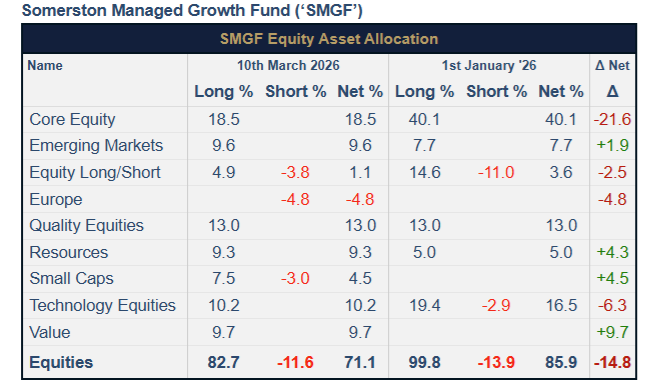
The tables below show our equity allocation compared to where allocation stood at the start of the year: Somerston Multi Asset Fund (‘SMAF’)

And:
Activity
We have reduced equity weighting in the Somerston Managed Growth Fund (SMGF) by 14.8% and a corresponding quantum in Somerston Multi Asset Fund (SMAF). Should our models confirm a higher probability of an enduring downturn, a further equity reduction will be more pronounced.
Just as importantly, the constitution of the equity book has changed meaningfully.
We have reduced exposure to our Core Equity strategy which is most exposed to potential ‘AI’ disruption of established, highly profitable companies.
The equity Long/Short strategy has been beneficial to the strategy in the first two months of the year, and we have taken partial profits.
We have increased exposure to emerging equities while reducing exposure to Europe. While investors have tilted from US assets, we see little merit in Europe, whereas both valuation and growth appear more compelling within emerging markets.
We have reduced exposure to the Technology sector. Longer term, we see substantial upside from the sector, however, we are going through a period of transition, and we perceive attractive opportunities in Value/Emerging/Resources and Smaller caps. Investors may be less willing to accept high valuations in the present environment, and while technology sector valuations have improved, they will only stay sustainable if companies can demonstrate long-term profitability. The threats from AI appear to build daily. Every AI announcement that exhibits significant productivity improvements is a hole in the moat of some of the most profitable Software companies in the world.
This war is not something President Trump can just ‘roll back’. Its implications are as economic as they are humane and there is no escaping that we are at significant risk of food inflation escalating, chip manufacturing slowing due to both lack of energy and chemicals, and far higher energy prices.
The risks to both growth and inflation are significant. Of course, should a resolution be found, these risks will abate, but the present path of events is not encouraging.
We continue to actively monitor all of our positioning and weight according to our interpretation of risk and opportunity.