Mid Month Update: Tactical Asset Allocation – Risk Off
“we have reduced equity exposure by more than 30%”
This commentary is provided for information purposes only. It is not investment advice, an offer, solicitation, or recommendation to buy or sell any security, fund, or financial instrument. This information is intended for professional investors only. For our full disclaimers, terms and conditions please follow this link: Disclaimer and Privacy Information - Somerston Asset Management
Against a market backdrop that we regard as structurally vulnerable, our tactical signals have changed.
For the first time this year, all three of our principal tactical models are now negative. In response, we have reduced equity exposure by more than 30% across our multi-asset strategies.
Tactical Asset Allocation
Throughout 2026, our Tactical Asset Allocation models had remained in a ‘risk-on’ regime. That changed on 16th September 2026.
Over the last twenty years, our models identify 12 distinct risk-on periods, together accounting for approximately 70% of the period.
During those risk-on regimes, the MSCI World Index generated an annualised return of 18.8%. During periods classified by the models as risk-off, the equivalent MSCI World Index annualised return was -13.6%*.

Source: Bloomberg, Tailwind, Somerston
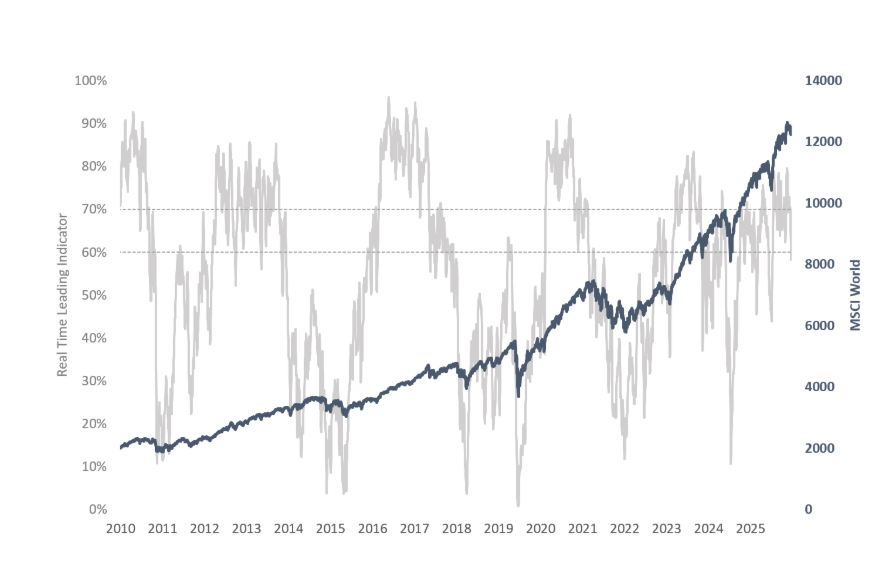
Until recently, our Real Time Leading Indicator, or RTLI, had remained supportive even as other elements of the model framework weakened.
That support has now disappeared.
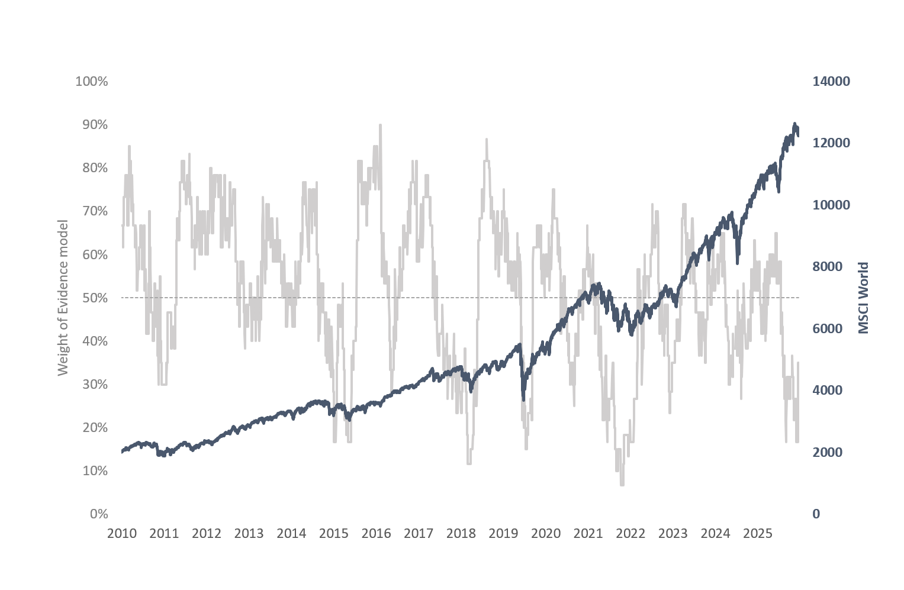
Credit and volatility indicators have rolled over sufficiently to complete what we describe as the ‘full house’: our RTLI, Weight of Evidence model and Accumulation model are now all giving negative tactical signals.
This does not in itself predict an imminent market correction. It does, however, represent a material change in the balance of risk identified by our models.
Chart 2: Real time Leading Indicator
Source: Bloomberg, Tailwind, Somerston
Chart 3: Weight of Evidence model
Source: Bloomberg, Tailwind, Somerston
Chart 4: Accumulation model

Source: Bloomberg, Tailwind, Somerston
Chart 5: Central Bank Diffusion vs. PMI lagged by 1 year
Historically, changes in global monetary policy have affected economic activity with a considerable lag. It is our belief that global central bank tightening will eventually catch up with economic growth.

Source: Bloomberg, Tailwind, Somerston
The Federal Reserve was another Central Bank to be removed from the list of Central Banks cutting interest rates yesterday (16th September 2026), raising its target rate by 25 basis points.
We expect the cumulative effect of tighter global monetary conditions eventually to weigh on economic growth.
Individually, none of these indicators is infallible. Taken together, however, the simultaneous deterioration across our principal tactical models represents a meaningful change from the environment that prevailed through most of 2026.
That change is now reflected in our positioning.
Please get in touch if you would like to discuss our interpretation of these signals and their broader market implications.
*These figures represent the historical performance of the MSCI World Index during periods classified by the models and do not represent the performance of an investable strategy or any Somerston fund.