Weekly Research Roundup
The S&P is now off more than -10% from its high. The more cyclical parts of the stock market such as Semiconductors, Autos and Homebuilders are all off -25% and Bitcoin is down -37%. Clearly, the market appears oversold on a near-term basis, moreover with global Central Banks on a rate-cutting path and the fall in the U.S. Dollar essentially 'coercing' a re-acceleration of global money supply, there are grounds for a decent bounce. However, these recent moves barely make a dent in normalising the structural excesses that have built up since the bull market began in 2009 and our leading growth index has rolled over sharply.
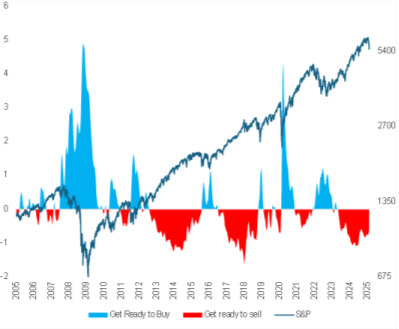
We have developed a composite indicator based on 1) Equity Valuations; 2) Credit Valuations; 3) Volatility valuations and 4) long term price trends. The blue and red series show us when we should be ready to buy and ready to sell the equity market. The chart on the right overlays our leading growth indicator. The optimal time to buy is when the series is blue, and our growth indicator is accelerating from a low. The optimal time to sell is when the series is red, and our growth indicator is rolling over from a top. Unfortunately, the latter is the setup today. Caution is warranted. See full comments here.

Stock Commentary:
Adobe (Not Held) – Q1 Earnings: Adobe reported an in-line quarter that ultimately failed to inspire investor confidence in its long-term AI strategy. Earlier this month, we sold the entirety of our Adobe position in both the Core Equity Fund and the Technology Fund. While we see an opportunity for Adobe to benefit from the advent of generative AI, the company’s strategy has been less clear than that of software peers such as Salesforce. The threat of disruption from AI start-ups remains a risk, and this quarter did little to assuage our concern. In the quarter, Adobe announced the ARR contribution from AI products for the first time ($125m), but any material growth inflection remains elusive. We will continue to follow Adobe going forward but remain on the sidelines at this stage. The stock lost 13.9% on the day. See full comments here.
Franco-Nevada (SMAF and Rainy Day) – Q4 Earnings: Franco-Nevada’s fourth-quarter 2024 results were bolstered by record gold prices and healthy outputs from its key mines, pushing revenue 6% higher year-over-year to $321m, surpassing expectations. Even though Cobre Panama’s shutdown weighed on sales, adjusted EPS still climbed 5.6%, and the company raised its dividend for the 18th consecutive time. Looking ahead, Franco-Nevada projects a 25% revenue surge in 2025 on the back of higher precious metals deliveries, newly acquired streams, and emerging mine developments. See full comments here.
Novo Nordisk (Core Equity Fund) – News Flow: Novo Nordisk stock was under pressure on Wednesday following a report from Roche that the company is entering into an agreement with Zealand Pharma to co-develop a rival weight-loss drug. Roche has been late to the market, and the recent $5.4bn commitment is a clear signal of their intent to catch up. The announcement underscores the increasing competitive pressures but also highlights the significant market potential seen by pharma executives. While competition remains a risk, it is important not to overlook the material head start the incumbents have in manufacturing. In light of the recent stock price weakness, we view Novo’s valuation as compelling relative to its closest peer, Eli Lilly. We therefore closed our position in Eli Lilly to add to Novo Nordisk. See full comments here.
Oracle (Technology Fund and Core Equity Fund) – Q3 Earnings: While Oracle’s third-quarter results marginally missed estimates, the guidance was very strong. The company reported remaining performance obligations of $130bn, up 62% year-over-year. Management reiterated FY’26 revenue targets ($66bn), which is encouraging as consensus estimates implied that the market had been sceptical of the figure. Importantly, the guidance assumes no benefit from the $500bn Stargate project, which remains a key ‘upside risk’ for the stock. While there may be some near-term margin pressure from data centre investments, we remain positive on the long-term outlook due to the compelling economics of customer migration from on-prem to cloud. The stock lost 3.1% on the day. See full comments here.
Please see the team’s Substack page, where we share research notes and updates: Somerston Asset Management Substack