Weekly Research Roundup
Good afternoon,
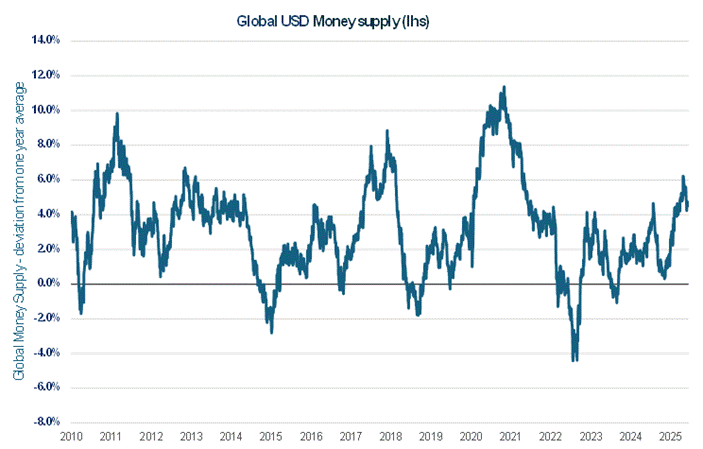
As we edge through a traditionally seasonally weak period for equity markets, we note that the momentum of global liquidity is starting to retreat from elevated levels. Furthermore, several financial relationships are starting to diverge - the equity bull market is not being accompanied by indicators that would ordinarily be in lockstep with equity markets. This suggests that the all-time highs in US equities may come under some near-term pressure. While these indicators are short term in nature, in the context of valuations near all-time highs, our Multi Asset Funds continue to maintain a moderately defensive strategy.
Stock Commentary
Adyen (Technology Fund) – Q2 Earnings: Adyen’s second quarter was mixed, as solid growth in the first half of the year was overshadowed by a reduction in the full-year revenue guidance. The reduction was due to macroeconomic pressure, as US tariffs weigh on e-commerce businesses based in Asia. Encouragingly, management reiterated the (admittedly wide) range for FY 2026 guidance, which appeared to address some investor concerns, judging by the price movements during the day. Importantly for our investment thesis, Adyen continues to gain wallet share from existing customers, while also executing well on new logo wins. Stepping back, the global payments ecosystem is only becoming more complex, with talk of new payment methods such as stablecoins. In this context, the role which Adyen fulfils for merchants becomes even more crucial—namely, enabling the global acceptance of a wide range of payment methods. We remain positive on the long-term trajectory for Adyen and acknowledge that periods of macroeconomic headwinds are expected. The shares lost 5.4% on the day.
Nvidia (Core Equity Fund and Technology Fund) – News Flow: On Monday, it was announced that Nvidia and AMD have reached an agreement with the US government to share revenue from chip sales to China in exchange for the lifting of export controls on specific products. The companies will pay 15% of revenue generated in China to the US government. As discussed in our previous notes, AMD and Nvidia management have done a good job of lowering market expectations for revenue from China this year. So, while the agreement is somewhat confusing in the context of Trump’s wider tariff policy, we view this as a positive for both companies, which can now earn some incremental revenue dollars from the world’s largest market for chips. That said, the Trump administration is still working out the details of the deal, due to some existing laws that regulate how the government can charge fees for export licenses.
Key results next week: Intuit.
Somerston Asset Management Limited is regulated by the Jersey Financial Services Commission