
Weekly Research Roundup
It was another week where tariff news weighed on US equities. Trump announced a 25% tariff on cars and car parts entering the US, despite industry experts’ warnings that the integration of the North American auto manufacturing sectors makes the definition of an ‘American-made’ car blurry. The announcement also caused much geopolitical backlash and further soured relations with new Canadian Prime Minister Mark Carney. The latest tariff news highlights that the pace of announcements is not slowing down, and the upcoming so-called ‘US Liberation Day’ will bring more headlines that may move markets.
The economic risk from the totality of Trump’s tariff war is material; if the new US administration proceeds with its proposed tariffs, the combined effects of these policies and likely retaliation from trade partners could push the US economy into recession. Financial markets do not currently reflect this risk, effectively assuming that Trump’s threats are a bluff. While it seems unlikely that President Trump would deliberately risk a recession, if one were to occur, it may be politically preferable for it to happen now rather than closer to the end of his term. A downturn could also help the government by bringing interest rates lower, which would ease the refinancing of the substantial short-term debt legacy from the Yellen era. A recession would almost certainly lead to lower bond yields. In the Somerston Multi Asset Fund, we remain underweight equities, and we may reduce our exposure further depending on how committed US policymakers are to this course of action.
Our leading growth indicator has now moved decisively below the 50 threshold, historically a key level separating periods of stronger and weaker risk-adjusted returns. Equity drawdowns tend to be deeper and take longer to recover when the indicator is below 50. In contrast, when above 50, market recoveries have generally been quicker. We cannot predict how this indicator will evolve in the coming weeks, but given high valuations and slowing growth, we advise caution.

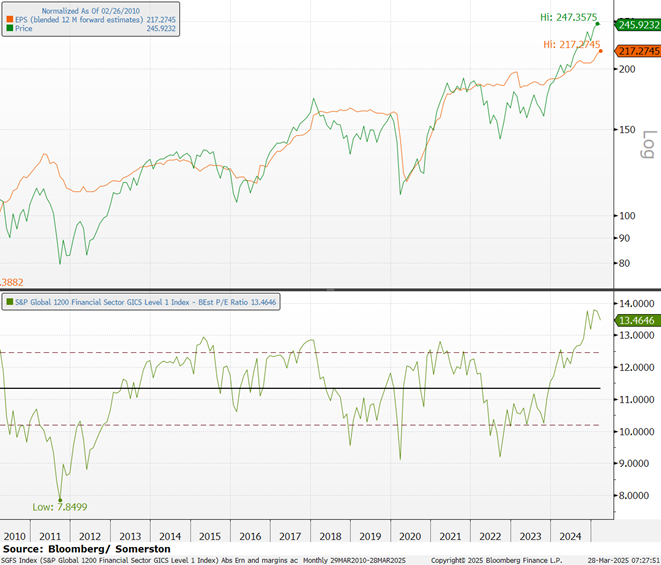
Encouragingly, we are now finding a number of stocks that appear to have fallen disproportionately. This presents an opportunity to reposition the portfolio towards assets offering stronger long-term return potential.
Stock Commentary:
Eli Lilly (Not Held) – News Flow: Eli Lilly’s Kisunla failed to get EU regulatory approval on Friday morning. Kisunla is part of a new class of drugs designed to slow the progression of Alzheimer’s disease. Regulators said that the benefits of the drug do not outweigh the risk of potentially fatal bleeding in the brain. The pre-market reaction has been relatively muted, reiterating that the obesity story remains the focus for investors. Indeed, the upcoming initial release from several late-stage clinical trials on Lilly’s once-daily obesity pill (orforglipron) will be closely watched. We recently sold our position in Eli Lilly, recycling the funds to Novo Nordisk on valuation grounds.
