Long Term Interest Rates

We share a brief mid-month update on our view of longer-term interest rates.
Long dated interest rates are at the epicentre of finance. They drive the cost of mortgages, government, corporate and municipal borrowings. They are the cornerstone for capital allocation decisions.
Central banks do not normally set long-term interest rates directly, although they influence them through policy rates and other monetary tools. Long-term yields reflect a broader assessment of inflation, debt supply, economic growth, fiscal credibility and the compensation investors require to hold long-duration assets.
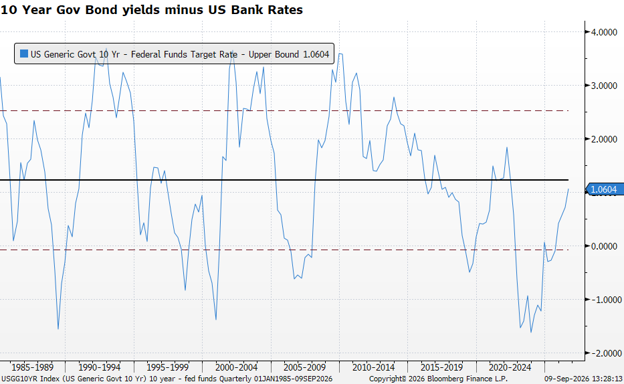
Several times over the last forty years, 10-year rates have been more than 3% above short-term rates. Contrary to Secretary Bessent’s indication ahead of the bond-market intervention this month, the 1 percentage point difference we now observe is broadly normal in a historical context.
Chart 1: 10yr Government Bond Yields minus US Bank Rates
Source: Bloomberg, Tailwind, Somerston
long-term rates are influenced by investors’ estimation of whether governments can continue to finance large deficits and growing debt levels
Nonetheless, it seems that bond investors are no longer simply concerned whether inflation will return to target or whether central banks will cut interest rates. Increasingly, long-term rates are influenced by investors’ estimation of whether governments can continue to finance large deficits and growing debt levels.
Investors continue to purchase government bonds, but appetite seems to have waned and long-term rates are drifting higher.
At a sufficiently high yield, the resulting increase in the government’s interest expense can itself worsen the fiscal position, creating a potentially self-reinforcing cycle whereby bond investors demand progressively higher yields to fund a deterioration in fiscal debt levels.
The concern is whether developed markets are already in a fiscal straitjacket, where effectively bond markets dictate policy. The UK appears particularly exposed to this dynamic.
Analysis by DoubleLine suggests that US interest costs as a percentage of tax revenue are already higher than at any time in the last 50 years.
The most important question is not simply how much debt a government has, but how much of its tax revenue is required to service that debt.
Interest costs are becoming harder to absorb
The interest-to-tax-revenue ratio can rise when:
- Tax revenue grows slowly.
- Nominal GDP growth weakens.
- Interest rates remain elevated.
- Existing debt is refinanced at higher yields.
- Governments continue to run primary deficits.
The result is a gradual reduction in fiscal flexibility.
In developed markets both tax revenues and GDP are growing, but existing debt is continually refinanced at higher rates and governments continue to run large primary deficits, even during very benign economic environments.
The assumption that governments can grow out of their debt burden is becoming less convincing, but it is critical that tax revenues and GDP continue to grow in nominal terms and that growth is faster than the rise in the cost of interest. This can be achieved through a combination of real growth and/or inflation.
Although large, the rise in US bond yields since 2020 seems fundamentally consistent with historical ranges based on the meaningful increase in nominal GDP in recent years. US ten-year yields are presently around 5% (15th Sep 2026); the most recent US GDP report showed growth of 6.5% and the three year average is 6.0%. The US is seeing the strongest nominal growth rates for 20 years.
Whereas the three years before COVID, US nominal growth was made up of 2.6% real growth and just 1.9% inflation, totalling 4.5% nominal growth, today nominal growth is made up of 2.2% real and 4.3% inflation. Not only is the inflation component substantially higher, but it is also broad based. Our analysis shows that of the 316 components of US CPI (inflation), over 50% of them are above 3%.
Insofar as high debt level and persistent deficits cause the inflation component of nominal GDP to rise, ever-expanding debt levels may place further upward pressure on bond yields. But the situation is delicate. The authorities need to avoid a vicious cycle of rising inflation causing real growth to falter and the currency to fall which risks producing a pernicious loss of confidence.
Chart 2: Trend GDP vs 10 year Rates

Source: Bloomberg, Tailwind, Somerston
Why developed markets are not all equally vulnerable
The developed-market bond market should not be treated as a single homogeneous market.
United States
The US benefits from:
- The world’s largest government bond market.
- The dollar’s reserve-currency status.
- A deep domestic investor base.
- Strong institutional demand.
- Monetary sovereignty.
However, the scale of its deficits and debt stock makes it increasingly sensitive to the level of long-term yields.
The US Treasury market is therefore likely to remain liquid, but the question is whether it can continue to absorb growing issuance without a substantial rise in the term premium.
United Kingdom
The UK is more exposed to market confidence than the US because it has a smaller domestic savings base relative to its financing requirements and a greater reliance on external investors.
Its high inflation sensitivity and large stock of index-linked debt also make the fiscal outlook more complicated.
The recent rise in 30-year gilt yields is therefore a particularly important warning signal.
Japan
Japan has a very high debt-to-GDP ratio but also a large domestic investor base and a long history of domestic financing.
Its risk is less likely to resemble a conventional foreign-funded sovereign crisis. Instead, the key issue is whether rising domestic yields, a changing Bank of Japan policy stance and the repatriation of capital can destabilise the domestic bond market.
The tell tail signs are already appearing

At this point, the bond market begins to influence fiscal policy directly. The most serious consequence of rising yields is not necessarily a collapse in bond prices. It is the loss of fiscal flexibility and the handicapping of industries that are sensitive to funding costs. This is the critical distinction between a normal bond-market correction and a fiscal confidence crisis.
When interest expenditure becomes a larger share of tax revenue, governments face difficult choices:
- Raise taxes.
- Cut spending.
- Reduce investment.
- Borrow more.
- Accept higher inflation.
- Allow the currency to weaken.
- Rely on central-bank intervention.
Each option has economic and political costs.
Governments delay the necessary adjustment because the immediate consequences are unpopular. That delay itself undermines confidence. The market then begins to impose discipline through higher yields.
This is why the long end of the yield curve is so important. It is not merely a forecast of future interest rates. It is also a market assessment of whether governments will eventually deliver credible fiscal adjustment. Yet, the higher cost of capital has widespread implications for many industries, which in turn hampers nominal growth and exacerbates fiscal deterioration.
Implications
Maintaining portfolio liquidity and valuation discipline seems increasingly sensible
While bond yields are at a valuation that we would historically consider to be attractive, the concern of fiscal deterioration is profound.
Should the concerns prove needless and if AI does drive a significant increase in productivity leading to a disinflationary period, there is no doubt that government bonds are attractive at present levels.
These are a very binary set of possible outcomes that profoundly impact the course of many asset classes. A gradual loss of confidence would be expected to support precious metals and bitcoin, but high nominal growth led by real growth and moderating inflation would be good for both equities and bonds.
The coincidence of fiscal deterioration and a market structure that appears fragile is highly noteworthy. We can employ tactical strategies that aim to ‘de-risk’ in a timely fashion, but these will never be foolproof.
Against this backdrop, maintaining portfolio liquidity and valuation discipline seems increasingly sensible.