Weekly Research Roundup
September 2025 Portfolio Commentary
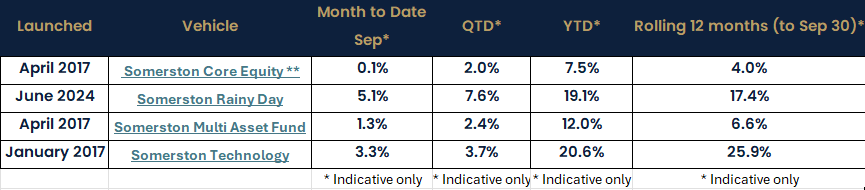
Ahead of the weeks resarch we start with a comment on the Somerston funds Q3 performance, all of which delivered positive returns. Full performance reports, including detailed attribution and underlying data, are now available via the embedded links to our website below:
The Multi Asset Fund rose 2.6% for the quarter, bringing year-to-date performance to +12%. Key contributors included precious metals and commodities, supported by gains in long volatility strategies. While equity selection and a cautious allocation weighed modestly on relative performance, the team continues to identify value in US inflation-linked bonds, and believes defensive equities remain well positioned should valuations remain elevated. The portfolio maintains a balanced stance — participating in growth while maintaining risk awareness.
The Core Equity Fund returned 2% over the quarter, and is up +7.5% year-to-date. Positive contributors included Alphabet, EssilorLuxottica, and Thermo Fisher, supported by resilient earnings and pricing power. Intuit and Novo Nordisk detracted, though both remain high-conviction holdings. Recent additions — including Intuitive Surgical, Ferrari, and Veeva — reflect the portfolio’s focus on high-quality, structurally growing, cash-generative businesses. Despite portfolio earnings rising approximately 14% this year, share prices have not yet fully reflected this improvement, leaving room for potential medium-term upside.
The Technology Fund returned +3.7% in the quarter, bringing the year-to-date gain to +20.6%. Performance continues to be driven by the fund’s exposure to the AI infrastructure theme, with holdings such as Nvidia, AMD, and Broadcom delivering strong returns. Contributions also came from Microsoft and Oracle, reflecting their positioning in AI-enabled services. The letter explores in detail how profitability in the AI ecosystem remains concentrated in infrastructure, while monetisation by software and model developers (e.g. Salesforce and Adobe) is at an earlier stage. Additions during the quarter included Duolingo, Veeva, and Intuit, where the team sees valuation pessimism as excessive.
The Rainy Day Fund returned +7.6% for the quarter, and is now up +19.1% year-to-date. The portfolio benefited from rising prices in gold, which remains supported by central bank and retail demand, and from strong performance in US and UK inflation-linked bonds. The portfolio continues to hold exposure to Bitcoin and volatility strategies, intended to provide asymmetric performance during periods of stress. The commentary highlights the structural debt burden facing developed markets and the growing strategic role of hard assets in a context of persistent fiscal imbalances — or, to borrow Hemingway’s framing, phenomena that change gradually, then suddenly.
This weeks comment:
A significant driver of asset price appreciation has been the growth in global USD liquidity. Global US Dollar Liquidity has been aided in the past six months by a falling US Dollar and compression in financial market volatility. In the last few days, we have been observing a slowing in the momentum of the upward trend in US Dollar Liquidity. This is a function of the mathematics of rising base effects rather than a change in policy. However, financial markets rarely distinguish these subtleties as much as they should. Our valuation indicators are in a ‘get ready to sell mode’ and the momentum of liquidity growth is slowing. The cycle remains on firm footing but any cracks in our leading indicators would correspond with market expectations flipping definitively lower.
Stock Commentary
· AMD (Technology Fund) - News Flow: OpenAI announced a new deal with AMD to buy GPUs with a total power consumption of 6 gigawatts. This likely represents tens of billions of dollars in revenue for AMD in the coming years—a significant jump for the company’s $12.5bn data centre business. As part of the deal, OpenAI will be issued warrants at 1 cent in tranches as the company buys AMD chips and contingent on a rise in AMDs share price. The total stake represents 10% of shares outstanding. The deal will see OpenAI purchase the upcoming MI450 chip, which aims to compete with Nvidia’s Blackwell. Reportedly, the purchases of chips will be used by OpenAI specifically for inferencing. AMD’s strengths in inference are a key reason behind our investment, so we see this deal as supporting our long-term thesis. The deal follows on the back of Nvidia’s $100bn investment in OpenAI in September, but this is a very different structure. Unlike the Nvidia deal, OpenAI is not receiving direct financing from AMD. This naturally raises the question of where the cash will come from. At this stage, it is unclear, as the award of warrants comes after the GPU purchases. Indeed, OpenAI’s commitments are fast stacking up; according to Blomberg estimates, this deal for 6 GW of compute power brings OpenAI’s net commitment in the range of 26 GW to 30 GW. AMD stock responded strongly, gaining 23.7% on the day. The stock continued its gains throughout the week and finished Thursday’s session 41.4% higher than where it started the week.
· Ferrari (Core Equity Fund) – Capital Market Day: It was a disappointing Capital Markets Day (CMD) from the luxury car manufacturer, as 2030 revenue and earnings targets came in below current market expectations. While the 2025 guidance was solid, management appeared cautious about the medium-term growth trajectory. We believe there is a dose of conservatism in these estimates and note that the company has a strong history of beating CMD targets. Nevertheless, the result caught the market off guard given recent optimism, and Ferrari’s US listing lost 15% on the day. During the CMD, the company reiterated its ‘scarcity-driven’ model and suggested that growth will come from average selling price (both mix and price) rather than volume. While this arguably leaves some revenue on the table in the near term (Ferrari is sold out until 2027, so it likely could increase volume), management is aiming to preserve the brand over the long term. We consider this a sensible strategy and see parallels to luxury leather goods maker Hermès, where exclusivity has been a key factor in sustaining long-term customer demand. We initiated a starter position in Ferrari stock in September. Importantly, the investment case for Ferrari is more than just the number of cars the company can sell. The business has a strong track record of highly efficient growth, resulting in the bottom-line growth far outpacing the top-line. With the EV ambitions being scaled back, Ferrari should have scope to continue improving its margin over time. Meanwhile, guidance suggests the company will remain highly cash generative. Indeed, management will increase dividends and buy back stock to return most of this cash to shareholders. We do not intend to build on our initial position at this time but will keep the holding under review for evidence of threats or support for our investment case.
· PepsiCo (Core Equity Fund) – Q3 Earnings: It was a better-than-feared quarter from PepsiCo, though pockets of weakness still remain. Positively, revenue and EPS for the quarter beat expectations, though we note that the EPS beat was helped in large part by a lower effective tax rate. Investor focus in recent quarters has been on the North American Frito-Lay segment (now called Foods North America). Weakness here continued, with volumes dropping 4% in the quarter. This suggests that PepsiCo needs to do more on the product innovation front to bring back customers. Indeed, this topic was flagged as a key priority by the CEO on the call. However, the North America Beverages business was better, posting the strongest growth in almost two years. Encouragingly, the international business, which we see as the primary growth driver in the coming years, continued to perform well. The company announced the retirement of the current CFO. Walmart executive Steve Schmitt is taking over and will be the first externally hired CFO in 20 years. We support an external candidate given the current strategic challenges in the US. Overall, despite headwinds persisting, the quarter showed progress in the US and continued strength internationally. The valuation remains undemanding, and expectations give room for upside surprises. The stock responded positively, gaining 4.4% on Thursday.
Key results next week: ASML.